The 10-Hour Manager: How AI Labor Forecasting and Automated Scheduling Fix the Hospitality Staffing Crisis
Discover how independent restaurants are overcoming the 2026 staffing crisis by using AI labor forecasting and automated scheduling to recover 10 management hours weekly and optimize labor costs.
The 10-Hour Manager: How AI Labor Forecasting and Automated Scheduling Fix the Hospitality Staffing Crisis
Introduction
The independent restaurant industry in 2026 operates in an environment of relentless economic compression. Operators face persistent wage inflation, shifting consumer dining habits, and an acute labor shortage that makes every single shift a delicate balancing act. At the center of this operational pressure cooker sits the general manager. Often expected to act as a part-time accountant, inventory specialist, human resources director, and floor leader, the modern general manager is stretched to a breaking point.
For decades, the standard operating procedure for managing restaurant labor has relied on a cocktail of intuition, historical sales averages scribbled in margin notes, and rigid spreadsheet grids. This traditional approach to scheduling is not just outdated; it is actively damaging restaurant profitability and accelerating executive burnout. When schedules are built on guesswork, the result is predictable chaos: overstaffing during unexpected slow periods that bloats labor percentages, followed by devastating understaffing during sudden rushes that ruins guest experiences and demoralizes the floor staff.
Enter the era of artificial intelligence in hospitality operations. The conversation around restaurant technology has matured far beyond simple digital menus and basic POS terminals. Today, forward-thinking independent operators are embracing AI labor forecasting and automated scheduling platforms. By transforming historical data, weather patterns, local events, and real-time sales curves into predictive intelligence, these tools are quietly revolutionizing back-of-house operations. More importantly, they are returning ten hours of administrative bandwidth every week to general managers, allowing them to step out from behind the computer screen and return to the dining room floor.
The Cost of the Staffing Crisis in 2026
To understand why traditional scheduling is broken, one must first examine the true financial and human cost of the current hospitality staffing crisis. Industry data consistently indicates that employee turnover remains one of the single largest drains on independent restaurant profitability. Replacing a single hourly frontline team member: accounting for recruitment advertising, onboarding time, administrative processing, and lost productivity during training: frequently exceeds six thousand dollars. When turnover ripples through a restaurant year after year, the cumulative financial loss can easily cripple an independent operator's net margin.
Compounding this turnover crisis is the administrative tax imposed on general managers. In a typical week, an independent restaurant manager spends between fifteen and twenty hours trapped in administrative tasks. The most time-consuming culprit among them is schedule creation and maintenance. Building a weekly roster requires cross-referencing availability sheets, verifying minor-age labor restrictions, calculating overtime risks, and negotiating around vacation requests. Once the schedule is published, the administrative burden shifts to crisis management: handling last-minute callouts, mediating shift-swap requests over chaotic group text threads, and adjusting headcounts on the fly.
This administrative obsession takes a severe psychological toll. General managers are hired for their leadership presence, their ability to mentor culinary and service talent, and their skill in driving guest hospitality. Instead, they find themselves spending their Sunday afternoons playing spreadsheet sudoku. The resulting burnout is a primary driver of executive turnover in the hospitality sector. When talented leaders burn out and leave the industry, the restaurant loses its institutional knowledge and operational consistency.
The downstream impact of this labor mismanagement inevitably reaches the dining room. When a restaurant is understaffed during a Friday evening rush because the schedule failed to anticipate a local event or a sudden surge in walk-in traffic, the operational gears grind to a halt. Kitchen ticket times stretch outward, food quality suffers under rushed execution, and front-of-house staff become overwhelmed. Diners notice the friction. Long wait times and hurried service lead directly to negative online reviews, lower average check sizes, and a permanent loss of repeat business.
Conversely, when reactive scheduling results in gross overstaffing during a rainy Tuesday lunch, labor costs spike unnecessarily. In an industry where net profit margins often hover between three and five percent, absorbing several hours of ghost labor: paying employees to stand idle because demand failed to materialize: can wipe out the profitability of an entire service period.
How AI Forecasting Changes the Math
The core limitation of manual scheduling lies in its reliance on lagging indicators. Traditional managers look at last Tuesday's sales figures to determine how many line cooks and servers to schedule for next Tuesday. While historical sales provide a baseline, they completely fail to account for the volatile variables that define modern consumer behavior. A sudden shift in local weather, a rescheduled high school sports tournament down the street, road construction blocking primary access routes, or a viral social media mention can render historical sales averages entirely useless.
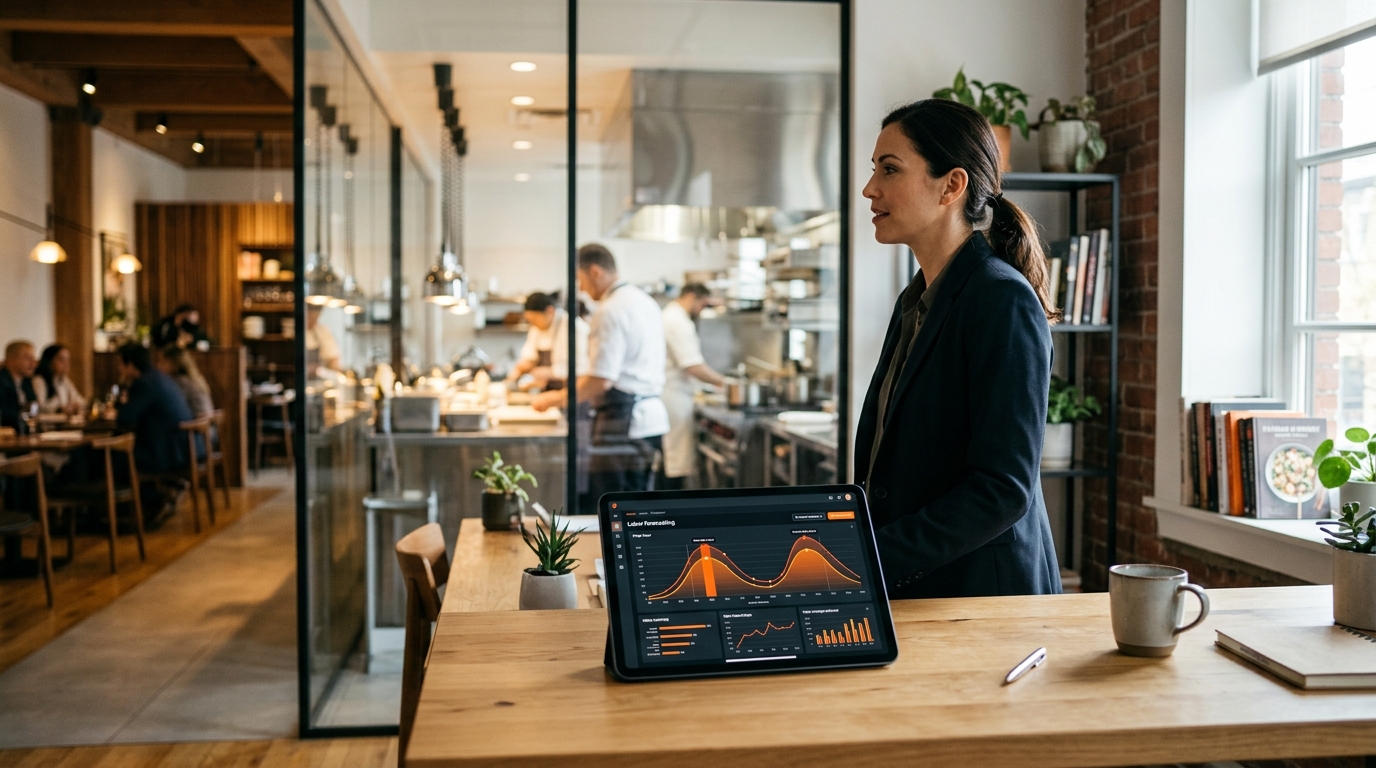
AI labor forecasting fundamentally alters this equation by replacing static averages with dynamic, multi-factor predictive intelligence. Modern AI workforce platforms ingest a wide array of data streams simultaneously. They analyze granular, fifteen-minute sales curves extracted directly from the POS system, cross-referencing them against hyper-local weather forecasts, regional event calendars, holiday schedules, and even real-time AI search trends indicating local consumer intent. By processing these variables continuously, the system generates highly accurate predictive demand curves for every hour of every operating day.
This transition from historical guesswork to predictive optimization brings profound precision to labor management. Rather than guessing whether four or six servers are needed for a Thursday dinner shift, the AI engine evaluates the predicted guest volume, average ticket times, table turn rates, and menu complexity to recommend an exact labor headcount down to the fifteen-minute increment. This level of granularity allows operators to maintain their target labor percentage: typically hovering between twenty-eight and thirty percent: without ever sacrificing service speed or guest satisfaction.
Furthermore, AI forecasting effectively eliminates the phenomenon of ghost labor. By identifying precisely when traffic is projected to taper off, the system prevents operators from scheduling redundant staff during the tail end of a shift. Employees are scheduled when their presence is genuinely required to drive revenue and deliver hospitality, protecting the restaurant's bottom line while ensuring that workers do not waste their time standing around an empty dining room.
To explore how these operational efficiencies fit into a broader technology framework, operators often examine the modern restaurant technology stack to understand how labor systems communicate seamlessly with inventory and point-of-sale infrastructure.
Automated Scheduling and the End of Shift-Swap Chaos
Once an AI engine establishes precise labor requirements, the next operational hurdle is constructing the schedule itself and managing the inevitable friction of daily schedule adjustments. In a traditional restaurant environment, schedule construction is an exercise in constraint puzzle-solving. The manager must juggle employee availability, requested time off, skill-mix requirements, overtime thresholds, and labor compliance laws, all while trying to distribute weekend shifts equitably among the team.
Automated scheduling software revolutionizes this process through constraint-based algorithms. The manager defines the operational parameters: such as requiring at least two experienced line cooks and three certified servers on duty during peak Friday hours: and inputs staff availability and skill certifications. The AI engine then generates an optimized draft schedule in seconds. The system automatically flags potential overtime risks, ensures compliance with minor-age working hour limitations, and respects individual availability preferences without requiring the manager to manually cross-reference paper calendars.
Beyond initial schedule creation, automated platforms transform day-to-day friction management through staff-facing mobile applications. In the old operating model, a server needing to swap a shift had to text coworkers, call the manager, and hope a physical paper sheet in the back office was updated. This decentralized communication channel resulted in frequent miscommunications, missed shifts, and administrative headaches.
Modern self-service mobile apps decentralize shift management while maintaining managerial oversight. If a team member needs to release a shift due to an illness or personal emergency, they submit the request through the mobile app. The platform instantly scans the active roster for qualified peers who have the correct skill certification and will not trigger overtime by picking up the shift. Once a compliant peer accepts the swap, the system updates automatically and notifies the general manager for a final one-tap approval.
This democratization of scheduling does more than save administrative hours; it fundamentally improves workplace culture and staff retention. Frontline hospitality workers consistently cite scheduling flexibility and transparency as primary factors in their employment decisions. Algorithmic scheduling removes the perception of managerial favoritism in shift distribution. When employees feel that schedules are fair, predictable, and easy to manage through their mobile devices, workplace morale rises, absenteeism drops, and retention rates improve significantly.
Reclaiming the 10-Hour Workweek for GMs
The ultimate dividend of implementing AI labor forecasting and automated scheduling is not merely a statistical reduction in labor percentage; it is the reclamation of human potential. When an independent restaurant successfully recovers ten to fifteen hours of administrative labor per week, the general manager is suddenly liberated from the tyranny of the spreadsheet.
Consider how a general manager's weekly calendar transforms when administrative burdens are lifted. Instead of spending five hours on Friday afternoon resolving schedule conflicts and callouts, that time is redirected toward high-value leadership activities that directly drive revenue and guest satisfaction.
First, the recovered time enables intentional staff development and mentorship. General managers can conduct one-on-one check-ins with front-of-house and back-of-house team members, run structured training sessions on new menu items, and foster a supportive workplace culture. In an industry where employee engagement is the strongest defense against turnover, dedicated leadership presence makes an immense difference.
Second, freed from administrative captivity, general managers can return to their rightful place on the dining room floor. During peak service hours, a manager who is not bogged down by operational fires can observe table pacing, greet regular guests, mentor younger servers in real time, and catch service friction before it manifests as a negative review. This active hospitality presence transforms the guest experience and builds lasting brand loyalty.
Third, the mental health dividend for leadership cannot be overstated. General managers who are no longer working sixty-hour weeks filled with repetitive paperwork experience significantly lower rates of burnout. Rested, focused leaders make better strategic decisions, communicate more effectively with their teams, and remain with the organization for years rather than months.
For a deeper look into how data-driven decision-making extends beyond labor into other areas of restaurant operations, reviewing predictive analytics metrics provides valuable insight into forecasting revenue and guest traffic months in advance.
The Kitxens Approach to Operations and Labor
Implementing advanced operational technology has historically been an exclusive privilege of large restaurant chains and multi-unit corporate franchises. Independent restaurants and boutique hospitality brands have often found themselves priced out or overwhelmed by complex enterprise software deployments that require dedicated IT departments to maintain.
Kitxens was founded to bridge this technological divide. Acting as your IT and POS department in the cloud, Kitxens delivers enterprise-grade operational tools designed specifically for independent operators. Our approach integrates AI labor forecasting, automated scheduling, and real-time POS data synchronization into a single, unified ecosystem.
Rather than forcing restaurant owners and general managers to act as amateur systems integrators, Kitxens provides comprehensive, seamless support across every technical layer. We handle the setup, data mapping, and ongoing optimization, allowing you to focus entirely on what you do best: crafting exceptional food and delivering memorable guest hospitality.
By streamlining operations, eliminating administrative waste, and providing proactive support through one centralized point of contact, Kitxens helps independent restaurants increase profitability and operational resilience without the high cost and complexity of managing internal IT staff.
Conclusion
The hospitality staffing crisis of 2026 cannot be solved by working harder with outdated tools. Spreadsheets, sticky notes, and reactive firefighting are relics of a bygone operational era that actively penalize independent restaurants through high turnover, inflated labor costs, and exhausted leadership.
By embracing AI labor forecasting and automated scheduling, independent operators can eliminate the administrative tax that drains their general managers. Recovering ten hours of management time per week is not just an efficiency gain; it is a fundamental transformation that restores joy to leadership, protects net profit margins, and elevates the guest experience. The future of independent hospitality belongs to those who leverage intelligent automation to empower their teams and secure long-term profitability.
Frequently Asked Questions
How does AI labor forecasting differ from traditional scheduling methods?+
Traditional scheduling relies on static historical averages and manual guesswork by general managers. AI labor forecasting ingests multi-factor real-time data including weather patterns, local events, POS sales curves, and search trends to predict labor demand down to 15-minute increments.
Can AI scheduling really save general managers 10 hours per week?+
Yes. GMs typically save 3 hours on initial schedule builds through automated constraint matching, 4 hours by decentralizing shift swaps to mobile self-service apps, 2 hours on emergency callout coverage via automated broadcast notifications, and 1 hour on payroll and compliance checks.
Will automated scheduling lead to understaffing during busy shifts?+
No. Because AI models evaluate granular sales data and external demand signals rather than crude weekly averages, they match staff headcount precisely to peak traffic periods, preventing both understaffing during rushes and expensive ghost labor during slow hours.
How does better scheduling improve employee retention and reduce turnover?+
Predictable schedules published well in advance, combined with easy mobile shift-swapping and transparent shift distribution, reduce workplace friction and burnout. This directly addresses major drivers of hourly employee turnover in the hospitality sector.
Do independent restaurants need expensive enterprise software to use AI scheduling?+
Not when partnering with a managed service provider like Kitxens. Kitxens integrates advanced labor forecasting and scheduling tools directly with your existing POS system, allowing the owner to focus on operations rather than technology.
What is the typical financial impact of implementing AI-driven labor management?+
Independent operators typically see a 3 to 5 percent reduction in total labor costs by eliminating ghost labor and unplanned overtime, alongside substantial savings from reduced employee turnover and increased management productivity.
Recommended next step
AI Workforce™
Your AI team working 24/7 — calls, reviews, reports and follow-ups without hiring more staff.
Starting from$199/mo
Learn more
Operations & Processes
Eva is the Kitxens operations AI. She writes about running a tighter restaurant — processes, staffing, kitchen flow, checklists and the systems that make service calm instead of chaotic.