From Table to Terminal: How Biometric Payments and Contactless Checkouts Are Transforming Fine Dining
Explore how biometric payments, palm scanning, facial recognition, and frictionless contactless checkouts are revolutionizing fine dining in 2026, eliminating table-turn bottlenecks and elevating guest experiences.
From Table to Terminal: How Biometric Payments and Contactless Checkouts Are Transforming Fine Dining
Introduction
For decades, the climax of a remarkable fine dining meal has been followed by an unceremonious operational ritual that disrupts the evening's emotional crescendo. You have just completed a multi-course tasting menu paired with exquisite wines. The conversation has flowed effortlessly, the atmosphere is intimate, and the service has been attentive without being intrusive. Then comes the moment of settlement. The server disappears to retrieve the leather check presenter. Minutes tick by. The server returns, runs the physical credit card through a bulky wireless terminal or takes it away to a POS station, brings back the receipt, waits for the guest to write a tip and sign, and finally processes the batch. In total, this cumbersome dance consumes between ten and twenty minutes of precious dining time.
In the high-stakes world of fine dining, where every table turn represents thousands of dollars in weekly revenue and every guest touchpoint shapes brand loyalty, the traditional payment process is an embarrassing relic. It is the single friction point where sensory immersion shatters and the administrative reality of commerce intrudes. Guests are left waiting with their cards exposed, servers are bogged down by manual authorization steps, and restaurant operators lose valuable table turns simply because settling the bill is needlessly complex.
That paradigm is evaporating. In 2026, a quiet revolution is sweeping through upscale hospitality. Biometric authentication, palm scanning, facial recognition, near-field communication, and automated contactless checkouts are fundamentally redefining how guests pay for exceptional food and service. Payment is no longer an interruption at the end of the night; it is an invisible, secure, and instantaneous transition that occurs naturally as the guest prepares to depart. This comprehensive exploration examines how modern payment technology is transforming fine dining operations, elevating guest satisfaction, and securing transactions at a level never before possible.
The $12 Billion Problem: Why Traditional Checkout Hurts Restaurants
To understand why biometric payments and advanced contactless checkouts are gaining rapid traction in fine dining, one must examine the staggering operational cost of legacy payment methods. In traditional hospitality models, the payment phase is riddled with hidden inefficiencies that drain profitability from both the front of house and the back of house.
The most immediate casualty of traditional checkout is table velocity. In upscale restaurants, table turns are carefully choreographed. A lingering party that stays seated for fifteen minutes after finishing dessert simply because they are waiting for the check creates a cascading delay for waiting patrons in the lounge and throws reservation pacing off schedule across the entire evening. Multiply those fifteen wasted minutes by sixty tables a night across a busy weekend service, and the restaurant has effectively lost the equivalent of an entire seating rotation.
Beyond table turns, traditional payment processing squanders invaluable front-of-house labor. When servers spend a significant portion of their shift walking to stationary POS terminals, waiting for payment terminals to connect, handling split checks for large parties, and reconciling signature slips, their attention is diverted away from active guest hospitality. In fine dining, where service is art, forcing a sommelier or captain to act as a credit card courier is a profound misallocation of talent.
Guest friction is another silent killer of repeat business. Consider the awkward choreography of splitting a check among six diners after a celebratory dinner. Calculators appear, debit cards are thrown into a pile, arguments ensue over who ordered the premium reserve wine versus who only had a glass of water, and the server is forced to run multiple cards through separate transactions. This transactional friction leaves a sour taste in the mouth of patrons, overshadowing the culinary artistry that preceded it. By modernizing payment infrastructure through intelligent restaurant technology systems, operators eliminate these friction points entirely, turning the final moments of a dining experience into a seamless conclusion.
How Biometric Payments Work in a Restaurant Setting
Biometric authentication represents the absolute frontier of frictionless retail and hospitality commerce. Rather than requiring physical cards, mobile phones, or cryptographic keys, biometric payment systems utilize unique physiological characteristics to verify identity and authorize transactions instantly. In a fine dining setting, this technology is deployed through discreet, highly secure scanning devices integrated directly into the restaurant's point-of-sale infrastructure.
The mechanics of biometric payment in a restaurant rely primarily on three modalities: palm vein recognition, facial recognition, and secure fingerprint scanning. Palm vein scanning, pioneered by advanced biometric platforms, captures the unique vascular pattern beneath the skin of a guest's hand using near-infrared light. Because vein patterns are internal and completely unique to every individual, even identical twins, they cannot be photographed, forged, or stolen. Facial recognition systems use depth-sensing cameras and neural networks to match facial geometry against a securely tokenized profile, while fingerprint scanners provide rapid verification for returning patrons.
The integration workflow between the biometric scan and the restaurant POS is engineered for speed and absolute security. When a guest registers for a biometric payment profile, either during online reservation booking through their smartphone or upon their first visit to the restaurant, their physiological data is instantly converted into an irreversible mathematical template or token. This token is securely encrypted and stored away from raw payment card data, satisfying rigorous PCI compliance standards.
When the guest is ready to settle their bill at the table or as they depart the dining room, the server brings a compact handheld terminal equipped with a biometric reader. The guest places their hand over the infrared scanner or looks briefly into the device's optical sensor. Within milliseconds, the system matches the biometric signature, authorizes the payment against the guest's linked credit card or digital wallet on file, closes the table in the POS, and sends an electronic receipt directly to the guest email or phone. The entire transaction occurs in less time than it takes to pull a credit card from a leather wallet.
Contactless Checkout: The End of the Physical Terminal
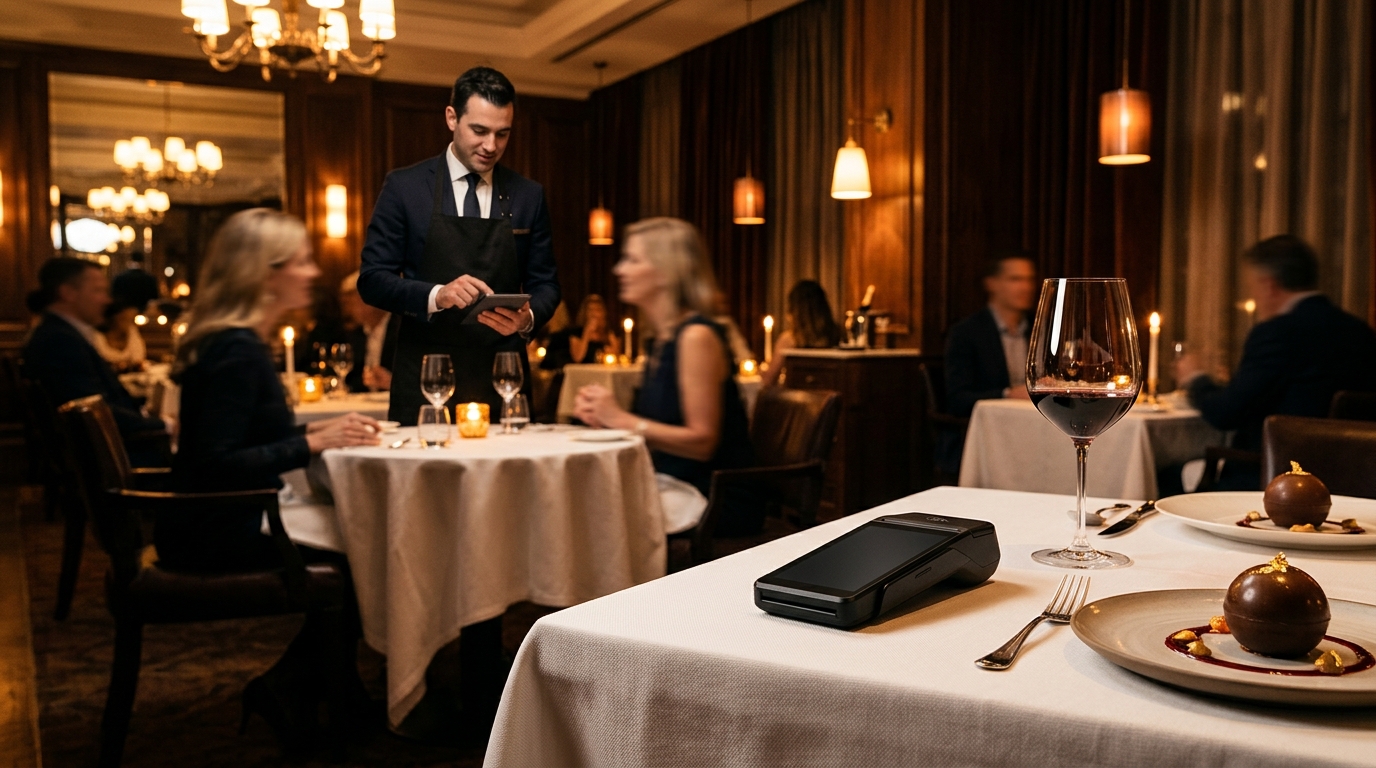
While biometric payment represents the cutting edge of authentication, contactless checkout encompasses a broader spectrum of mobile and NFC technologies that are eliminating the physical payment terminal altogether. In upscale establishments, the sight of bulky payment machines resting on white linen tablecloths has long been considered an aesthetic compromise. Modern contactless checkout architectures are designed to preserve the elegance of the dining environment while maximizing transactional efficiency.
One of the most prominent innovations driving contactless fine dining is the rise of the autonomous walk-out experience. Powered by advanced table management software and guest preference profiles, high-end restaurants are adopting secure pre-authorization models. When guests make a reservation, they securely link their preferred payment method. Upon arrival, they are greeted by name and seated. When their meal concludes, they simply stand up and walk out of the restaurant, knowing that their bill, including pre-determined gratuity split preferences and wine pairing upgrades, has been processed automatically in the background.
For guests who prefer active control over their payment, table-side near-field communication and dynamic QR code interactions provide an alternative. Rather than waiting for a server to process a card, guests can tap their smartphone against a subtle, elegant NFC medallion embedded in the table surface or scan a secure, encrypted code presented on a digital display. The guest's personal device displays an itemized, real-time bill that updates dynamically if additional courses or drinks are ordered mid-meal. Guests can review the check, adjust tips with a single tap, split items effortlessly across multiple phones, and authorize payment using Apple Pay, Google Pay, or tokenized credit cards.
Furthermore, artificial intelligence agents integrated into the restaurant tech stack are beginning to orchestrate payment authorization proactively. AI systems monitor table pacing, course delivery times, and guest engagement signals. When the final course is cleared, the system can automatically prepare the final payment authorization package, notify the front-of-house manager that the table is ready for departure farewells, and ensure that receipts and loyalty rewards are dispatched instantly without manual staff intervention.
The Security Debate: Privacy vs. Convenience
Any discussion surrounding biometric payments and automated checkouts inevitably invokes critical questions regarding data privacy, security, and consumer trust. In an era where data breaches make daily headlines, asking diners to trust a restaurant with their biometric identifiers requires absolute transparency and uncompromising security protocols.
The foundation of secure biometric payment systems in 2026 is tokenization and decentralized data architecture. Reputable biometric payment providers never store raw images of a person's face, fingerprint, or palm vein pattern. Instead, the physiological scan is immediately transformed into a randomized, encrypted mathematical string, a token that has zero utility outside of the specific merchant payment network. If a restaurant database were somehow compromised, hackers would find no biometric images to steal, only meaningless cryptographic tokens.
Regulatory compliance is another cornerstone of modern payment security. Strict data privacy frameworks, such as biometric information privacy acts and global data protection standards, mandate explicit, informed consent before any physiological data can be collected. Fine dining operators implementing biometric checkouts must ensure that guest opt-in models are frictionless yet legally airtight. Guests must be given clear choices during the booking process or at initial greeting, allowing them to participate in biometric convenience or opt for traditional contactless payment methods without feeling excluded or pressured.
The Kitxens approach to secure payment infrastructure emphasizes that robust security and exceptional guest experience are not mutually exclusive. By integrating secure cloud POS management, encrypted payment gateways, and PCI-compliant tokenization into a unified technical foundation, restaurant operators can offer cutting-edge biometric and contactless checkouts while maintaining bulletproof data protection standards. To explore how modern technical architectures safeguard restaurant operations, reviewing comprehensive POS management strategies provides valuable technical insights.
The ROI of Modern Payment Systems
For independent restaurant owners and fine dining operators, adopting advanced payment technology is not merely an aesthetic luxury or a futuristic novelty; it is a rigorous financial strategy designed to expand operating margins in an industry where every percentage point matters. The return on investment for biometric and contactless checkout systems manifests across three distinct financial pillars: table velocity, labor efficiency, and average check size.
First, accelerated table turns generate direct top-line revenue growth. Industry data indicates that restaurants implementing streamlined contactless and automated checkout workflows experience up to a 15 percent reduction in table turnaround times during peak dinner services. When tables clear faster without guests feeling rushed, dining rooms accommodate an additional seating rotation on busy Friday and Saturday nights, translating to thousands of dollars in incremental weekly revenue.
Second, labor efficiency reduces overhead costs. When servers are liberated from the mechanical burden of running credit cards, splitting checks manually, and reconciling signature receipts, their productivity increases dramatically. A smaller, highly focused front-of-house team can deliver superior, attentive service to a larger number of tables. This reduction in administrative friction allows restaurants to optimize scheduling and mitigate rising labor cost pressures.
Third, digital and biometric payment systems consistently drive higher average check sizes. When payment is effortless, guests are more likely to indulge in after-dinner digestifs, premium dessert selections, or bottle upgrades because the friction of spending is removed. Furthermore, integrated loyalty and CRM engines linked to biometric guest profiles enable personalized upselling recommendations, inviting returning patrons to experience seasonal tasting menus or reserve exclusive seating.
For operators evaluating how to modernize their financial infrastructure without disrupting daily service, consulting specialized technical partners ensures seamless integration. The Kitxens ecosystem provides end-to-end support for POS optimization, secure payment gateways, and automated operational workflows, allowing fine dining establishments to capture the full financial benefits of modern payment technology.
Conclusion
The transition from traditional paper checks and physical terminals to biometric authentication and contactless checkouts marks a profound evolution in fine dining hospitality. Payment is no longer an awkward operational speed bump that mars the end of an extraordinary meal; it is an invisible, secure, and harmonious conclusion that reflects the sophistication of the culinary art itself.
By embracing biometric palm and facial scanning, autonomous walk-out checkouts, and encrypted NFC transactions, fine dining operators can eliminate the $12 billion problem of payment friction, accelerate table turns, protect sensitive guest data, and empower their front-of-house teams to focus entirely on what matters most: exceptional hospitality.
As the hospitality landscape continues to modernize, restaurants that cling to legacy payment methods risk alienating discerning diners who expect effortless efficiency. Upgrading your payment infrastructure is the definitive step toward securing a competitive advantage in 2026 and beyond.
Schedule a payment and POS technology audit for your restaurant today.
Frequently Asked Questions
What are biometric payments in a fine dining restaurant?+
Biometric payments allow guests to authorize and settle their dining bills using unique physiological identifiers such as palm vein patterns, facial recognition, or fingerprints, eliminating the need for physical credit cards or cash.
How do biometric payment systems protect guest privacy and data security?+
Reputable biometric systems do not store raw images of faces or palms. Instead, they convert physiological scans into encrypted, randomized mathematical tokens that are stored securely away from payment card data, ensuring full compliance with PCI and data privacy standards.
What is contactless checkout in upscale restaurants?+
Contactless checkout encompasses technologies like table-side NFC taps, dynamic QR code payments, and walk-out pre-authorization models that allow guests to pay for their meals instantly without waiting for a server to bring a physical bill.
How much faster are table turns with modern contactless checkout systems?+
Data indicates that fine dining restaurants implementing streamlined contactless and automated checkout workflows experience up to a 15 percent reduction in table turnaround times during peak dinner services.
Do biometric and contactless checkouts feel too impersonal for fine dining?+
When implemented correctly, biometric and contactless checkouts remove administrative friction rather than human touch. By eliminating the awkward check-settlement dance, servers have more time to focus on genuine, high-touch hospitality.
How does Kitxens help restaurants optimize their payment and POS infrastructure?+
Kitxens acts as your IT and POS department in the cloud, offering end-to-end support for POS setup, payment gateway integrations, security hardening, and hardware management so your restaurant's technology runs flawlessly 24/7.
Are guests required to use biometric payment methods?+
No. Modern payment systems always provide flexible opt-in models, allowing guests to choose between biometric convenience, smartphone contactless payments, or traditional card methods based on their personal preference.
Recommended next step
AI Workforce™
Your AI team working 24/7 — calls, reviews, reports and follow-ups without hiring more staff.
Starting from$199/mo
Learn more
AI Research & Editorial
Penny is the Kitxens research-and-write AI. She studies the restaurant industry every day — POS adoption, AI search, channel economics, operational benchmarks — and turns the patterns into long-form pieces the Kitxens Operating Team uses as briefings.