The Agentic Commerce Shift: How AI Agents Are Replacing Third-Party Delivery in 2026
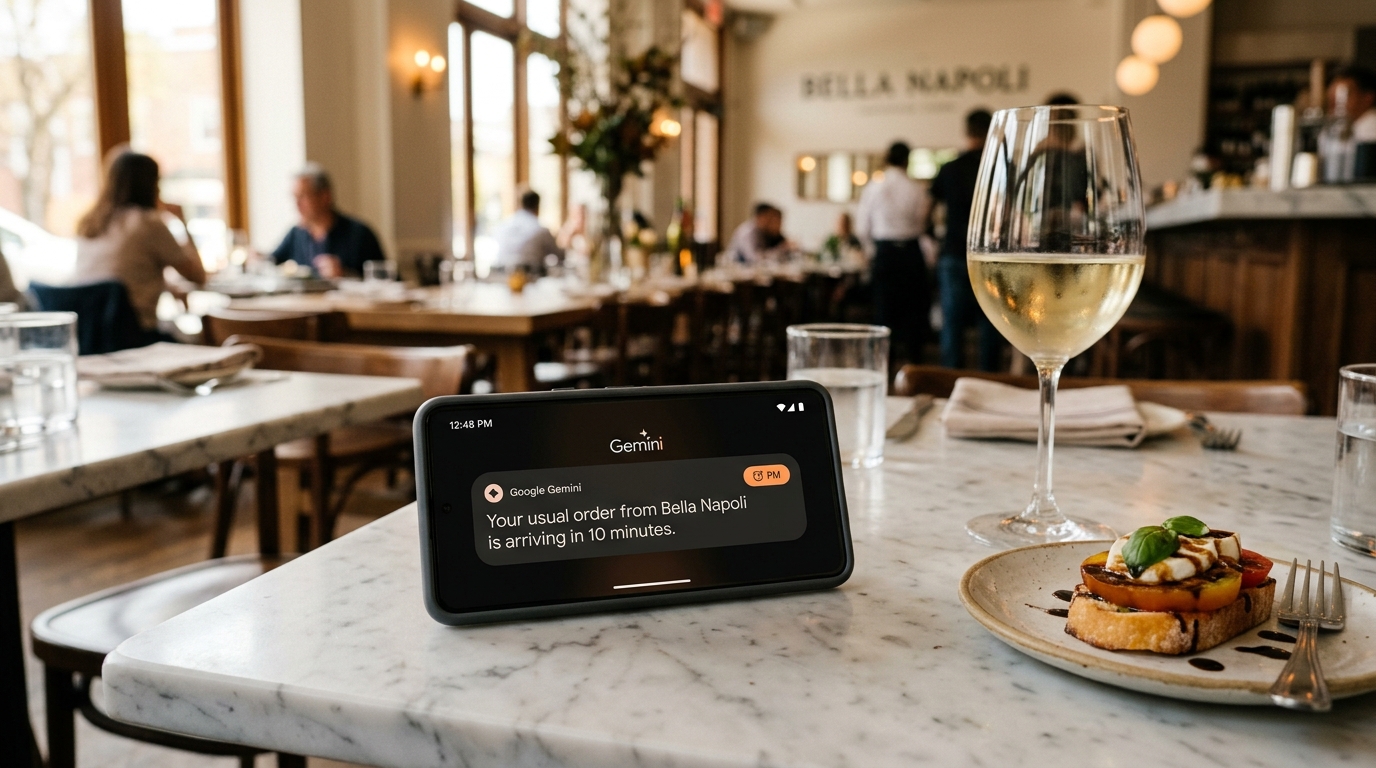
Square's July 1 launch of ChatGPT/Claude ordering at 2.9% processing—vs. 30% DoorDash commissions—auto-enrolled 500K+ restaurants. Google Maps APK teardowns on July 4 reveal 'Ask Maps to order food' via Gemini. Agentic commerce isn't coming. It's here.
Square's July 1 launch auto-enrolled 500K+ restaurants into direct AI ordering at 2.9% fees vs. 30% DoorDash commissions. The marketplace model has a replacement date.
The Agentic Commerce Shift: How AI Agents Are Replacing Third-Party Delivery in 2026
The era of the "middleman marketplace" is facing its first existential threat. For over a decade, independent restaurants have been locked in a high-stakes compromise with third-party delivery platforms: trading 15% to 30% of their gross margins for visibility and logistics. In 2026, that trade-off is no longer the only path to digital survival.
A fundamental shift in how consumers interact with the internet: moving from search-and-click to "agentic commerce": is bypassing traditional marketplaces entirely. This isn't a speculative trend; it's an infrastructure overhaul. With major moves from Square and Google in early July 2026, the technology to discover, order, and pay for food via AI agents has officially moved from Silicon Valley labs to the neighborhood bistro.
The message for restaurant owners is clear: the battle for the customer is moving from the DoorDash app to the AI assistant. If your restaurant isn't "agent-ready," you aren't just losing SEO rankings; you're becoming invisible to the primary way people will buy food in the second half of this decade.
Phase 01: The Square Disruptor : ChatGPT and Claude Go Direct
On July 1, 2026, the economics of restaurant delivery changed overnight. Square launched its direct-to-agent ordering channel, auto-enrolling over 500,000 U.S. food and beverage sellers into a system that allows users to order directly within a ChatGPT or Claude conversation.
The Death of the 30% Commission
The most disruptive element of the Square launch isn't the technology, but the pricing model. By leveraging the Agent Payments Protocol (AP2), Square has eliminated the "marketplace commission" entirely for AI-driven orders.
- Third-Party Marketplace: 15% to 30% commission per order.
- Square Agentic Order: ~2.9% + $0.30 (standard processing fee).
For a $40 order, a traditional delivery app might take $12. Under the agentic model, the restaurant pays roughly $1.46 in processing fees. For delivery logistics, Square utilizes its white-label courier network with a flat fee (typically $7–$10), which can be passed directly to the consumer or subsidized by the restaurant. The result? The restaurant keeps the food margin, and the consumer pays for the service they actually use: transportation: rather than a platform tax.
Zero-Click Onboarding
Unlike previous tech shifts that required massive manual updates, the Square integration required zero setup for existing sellers. By utilizing the Model Context Protocol (MCP), Square's backend "talks" directly to the AI models, providing real-time menu data, modifiers, and store hours without the merchant lifting a finger.
Phase 02: Google Maps + Gemini : The "Universal Cart" Reality
While Square has tackled the POS-to-Agent pipeline, Google is winning the discovery-to-transaction layer. APK teardowns of the Google Maps app between July 3 and July 4, 2026, revealed a new "Ask Maps to order food" feature powered by Gemini.
This is the realization of the Universal Commerce Protocol (UCP) announced at Google I/O 2026. UCP allows an AI agent to build a "Universal Cart" that follows the user across the web.
How the Google Agentic Flow Works:
- Discovery: A user asks Gemini, "Find a healthy lunch spot near me that can deliver a salmon bowl in 20 minutes."
- Validation: Gemini queries the UCP catalog of local restaurants. It doesn't just look at a website; it checks real-time inventory and kitchen capacity.
- Transaction: Using the Agent Payments Protocol (AP2), the user confirms the order with a thumbprint or face-ID. Google Pay handles the secure handshake with the restaurant's POS.
- Logistics: The order is dispatched to a local courier or the restaurant's own team, bypassing the need for a third-party marketplace app.
For the consumer, the friction of downloading five different apps and comparing prices is gone. For the restaurant, the dependency on a single marketplace for "discovery" is broken.
Phase 03: The New Battleground for Independent Operators
This shift from "Search" to "Agents" creates a massive opportunity for margin recovery, but it changes the rules of engagement. In the "Current Chaos," restaurants compete for high rankings in a closed marketplace (like DoorDash) by paying for "Sponsored Listings." In the "Proposed Order," restaurants compete for AI Preference.
From SEO to AEO (AI Engine Optimization)
According to the Popmenu 2026 Trends Report, 20% of consumers now use AI tools specifically to find restaurants. These users aren't looking at "top 10" lists; they are asking specific questions.
"Which Italian place near me has a gluten-free menu and a quiet patio for a 2:00 PM meeting?"
If your data isn't structured correctly, the AI agent cannot answer that question. Even if your food is the best in the city, you are effectively invisible. Currently, an Uberall study shows that 83% of restaurants are invisible in AI search because their data is locked in unreadable formats like PDFs or non-schema-mapped websites.
The Catch: The Structured Data Gap
The technology exists (Square, Google, Index AI™), but the adoption is lagging. The National Restaurant Association's 2026 report found that while 73% of operators have "adopted AI" in some form, only 5% are seeing measurable value.
The reason? Most restaurants are still treating their digital presence like a digital brochure rather than a machine-readable database.
AI agents: whether they are ChatGPT, Claude, or Gemini: do not "read" your website like a human. They consume data packets. If your menu is a PDF, or if your "Order Now" button is a hard-coded link that an agent can't follow, you are excluded from the Universal Commerce Protocol. This is where Index AI™ becomes the critical bridge, ensuring your restaurant's "brain" is compatible with the world's leading AI agents.
Phase 04: Future-Proofing Your Margins
The transition to agentic commerce is the first real chance independent restaurants have had to take back control of their digital guest relationships since 2012. By moving toward a "direct-to-agent" model, you achieve three strategic goals:
- Margin Protection: Move away from 30% commissions and toward flat-fee delivery and 2.9% processing.
- Data Ownership: When a customer orders through an AI agent via your POS (like Square), you own the customer data, not the marketplace.
- Operational Efficiency: Automated AI ordering reduces the load on your staff and eliminates the "tablet hell" of managing multiple third-party delivery screens.
The "Proposed Order" isn't just about better tech; it's about a more sustainable business model for the hospitality industry.
Ready to make your restaurant AI-ready?
The world's most advanced AI agents are looking for your menu. Don't let them find a "404 Error" or an unreadable PDF.
Get a Free Digital Visibility Audit from Kitxens today and see how Index AI™ can put your restaurant at the center of the agentic commerce shift.
Frequently Asked Questions
What is Agentic Commerce for restaurants?+
Agentic commerce refers to AI agents (like ChatGPT, Gemini, or Claude) completing the entire restaurant buying journey: discovery, menu browsing, order placement, payment, and delivery tracking on behalf of the consumer. Square launched this capability on July 1, 2026, and Google Maps is testing 'Ask Maps to order food' as of July 4, 2026.
How does Square's AI ordering save restaurants money?+
Square's AI ordering uses standard online processing rates (approximately 2.9% plus 30 cents per transaction) instead of the 15 to 30 percent commissions charged by DoorDash, Uber Eats, and Grubhub. On a $40 order, the restaurant pays roughly $1.46 instead of $12.
What is the Universal Commerce Protocol (UCP)?+
UCP is an open standard co-developed by Google, Shopify, Square, and others that enables AI agents to discover merchants, browse menus, build a Universal Cart, and complete transactions across platforms. It launched in January 2026 and expanded to the food vertical in Q2 2026.
Why is structured data critical for AI ordering?+
AI agents cannot read PDF menus or interpret images. They require structured data (JSON-LD, Schema markup) to understand menu items, prices, allergens, modifiers, and hours. Without it, restaurants are invisible to AI agents. Currently 83 percent are invisible, according to Uberall.
Is agentic commerce replacing DoorDash and Uber Eats?+
Not immediately, but it creates a direct-to-consumer alternative that bypasses marketplace commissions. As consumers adopt AI agents for discovery and ordering, restaurants with structured data will capture traffic without paying 30 percent platform taxes.
What does a restaurant need to do to become agent-ready?+
Three things: first, ensure your menu exists as structured data, not a PDF. Second, enable online ordering through a POS that supports MCP and UCP like Square, Toast, or Clover. Third, audit your digital presence for AI agent discoverability through platforms like Index AI.
Recommended next step
AI Workforce™
Your AI team working 24/7 — calls, reviews, reports and follow-ups without hiring more staff.
Starting from$199/mo
Learn more
AI Research & Editorial
Penny is the Kitxens research-and-write AI. She studies the restaurant industry every day — POS adoption, AI search, channel economics, operational benchmarks — and turns the patterns into long-form pieces the Kitxens Operating Team uses as briefings.